Welcome to Jiayuguan. Your tour guide will meet you in the airport/train station in the morning, and then escort you to your hotel.
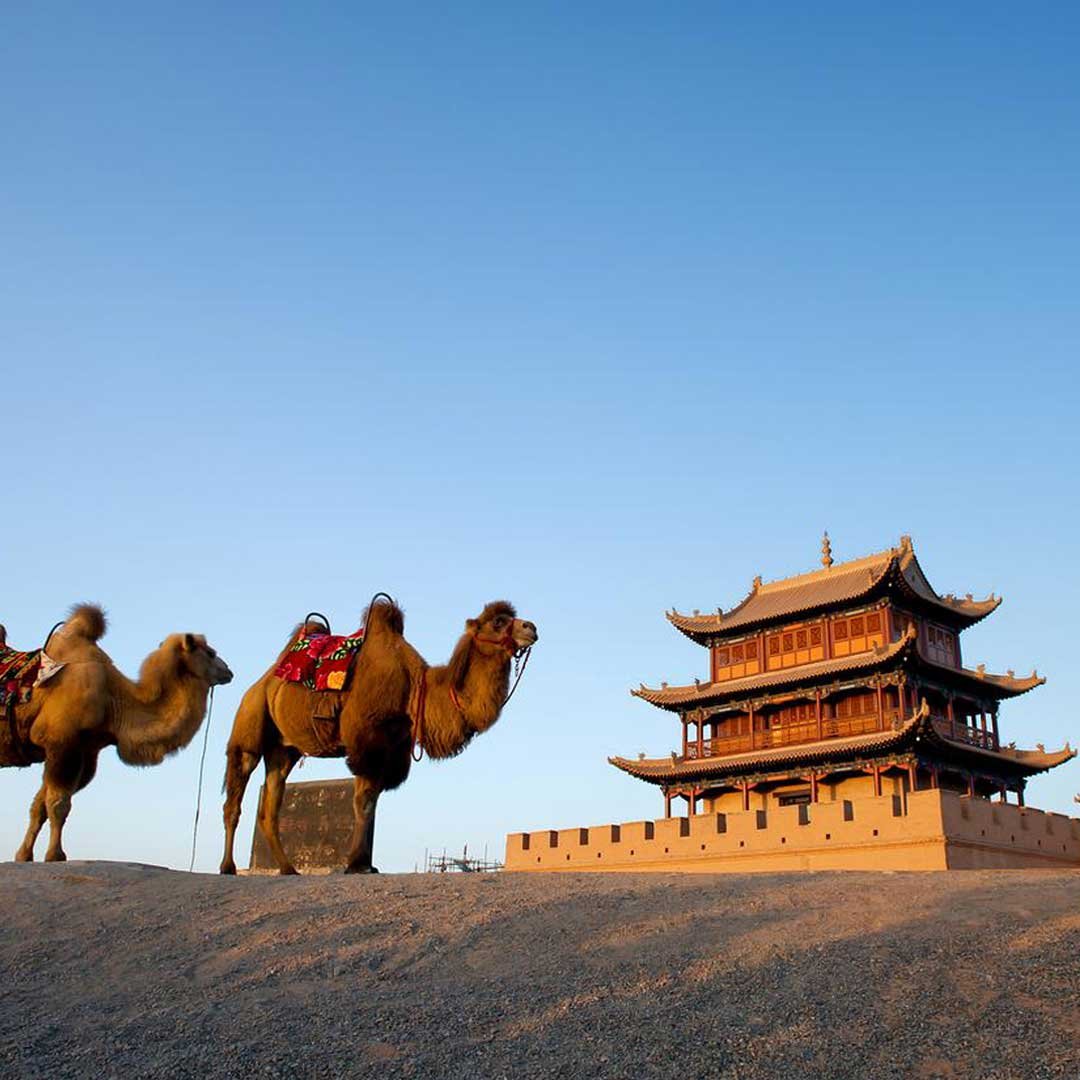
In the afternoon, drive about 10 minutes to visit the Jiayuguan Fort. Before entering the fortress, take a short visit to the Great Wall Museum to learn some interesting facts about both the Jiayuguan Fort and Great Wall, including history, old photos, relics, etc. Then enter the gate to explore the grandiose fortress. The fort is the farthest fortress of Great Wall of Ming Dynasty. It is a complex of towers, city walls and other military buildings covering more than 25,000 square meters. The city wall is nearly 11 meters high, and comprises an outer and inner wall. There are two large gates standing at the east and the west of the inner wall. Walkways lead to the top of the wall, allowing horses to climb up the wall in the ancient time.
Leave Jiayuguan Fort, and drive to visit the Xuanbi Great Wall (Overhanging Wall) which is about 18km away from the Fort. The walls were built on lofty cliffs with incredibly large gradient looking like an overhanging cantilever. Climbing up to higher gives you excellent views of the surrounding land and mountains.
Today you will travel to Dunhuang from Jiayuguan in the early morning. On route, visit Yulin Grottoes which is known as the “sister caves” of Mogao caves. It is a Buddhist cave temple site located about 160 km east of the oasis town of Dunhuang and the Mogao Caves, and was listed as the UNESCO World Heritage sites as part of the Chinese Section of the Silk Road. There are 43 existing caves in the Yulin Caves, with a total of 5,200 square meters of murals and more than 259 colored sculptures. You can visit up to 5 caves in which you can admire magnificent mural paintings which are believed to be even more beautiful than those in Mogao Caves. There are also 4 “special caves” (No. 2, No. 3, No. 4 and No. 25) with outstanding art value that you can visit with extra charges.
After arriving at Dunhuang city, check in to your hotel.
Nightlife Idea: go out for a walk in the Shazhou Night Market where you can try some local food, relax in a drinking bar, or buy some interesting handcrafts, etc.
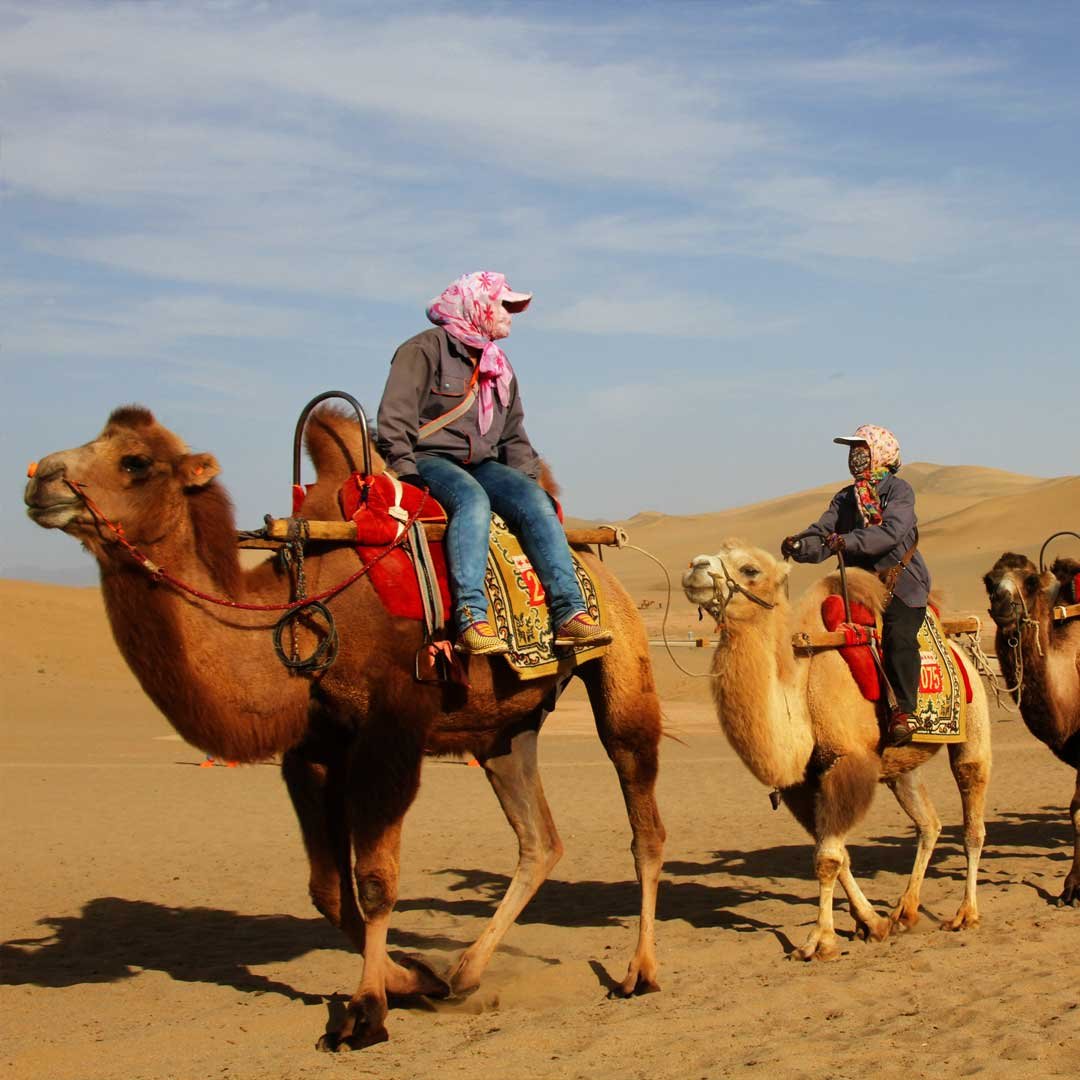
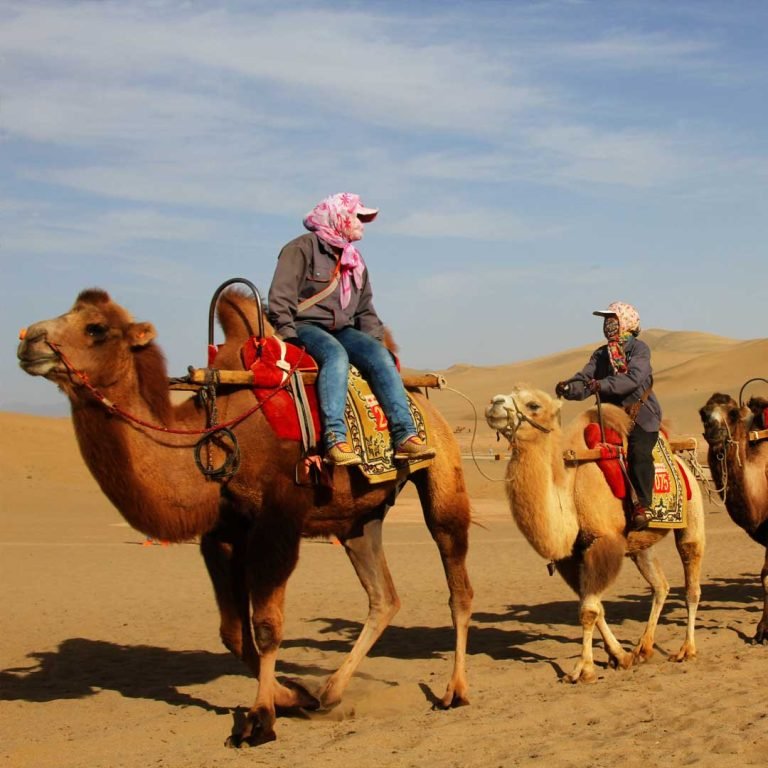
After breakfast, you will be taken to explore the remote wild Gobi Desert landscape as well as several legendary historical sites. Drive westwards about 100 km, you will firstly arrive at Yumen Pass (Jade Gate Pass) which used to be a military defensive pass as well as an important border for international trading along the ancient Silk Road. It is said that the jade wares from West were imported to China through this gate, which is how the name Yumen was given. About 5 km from Yumen Pass is the Ruin of Great Wall of Han Dynasty which was built to fight against Xiongnu in the ancient time. Keep driving more 80 km, you will get to Yardang National Geologic Park. It is also called Devil City in that you will hear the sound just like the devil screaming when the strong wind goes through the desert. The park is featured Yardang landforms in distinct shapes like Mongolian Yurt, Stone Bird, Peacock and others. Make full use of your imagination, you may find some rocks with some miniatures similar to famed architectures, like the Potala Palace in Tibet, Heaven Temple in Beijing or something else.
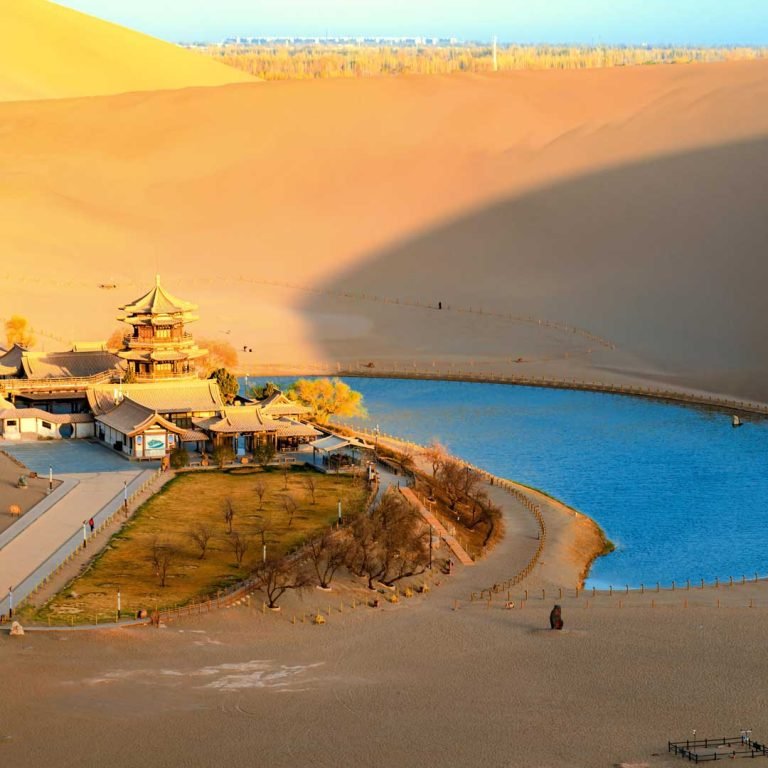
Leave Yardang National Geologic Park, and drive along the coming way back to Dunhuang. The following attraction is the Echoing Sand Mountains (Mingshashan). It is said, in the sunny days, the sand mountains echo like Orchestra music even if there is no wind. If you slide from the sand mountains, you can hear the echoing sound clearly. Your last thing to do for today is the Crescent Lake. Surrounded by the Echoing Sand Mountains, Crescent Lake is a beautiful oasis with some well decorated traditional Chinese architecture, some trees and flowers and a lake that has never dried up and shapes like a crescent moon.
Nightlife Ideas: 1) Go out to go for a walk in the Shazhou Night Market where you can try some local food, relax in a drinking bar, or buy some interesting handcrafts, etc. 2) Enjoy the fascinating Silk Road Show – Ancient Sound of Dunhuang. Through the use of high-tech methods such as holographic projection and 3D visuals, it presents a fully immersive theatrical experience of both elaborate dances and unique performance of ancient musical instruments. (Notice: the Silk Road Show is not available during November to middle April of next year. The tickets of the show sell out quickly. If you want to watch the show, please let your travel consultant or tour guide know in advance.)
Useful Tips: 1) Pack some food and water for the long driving on the desert; 2) get fully prepared for the strong sunlight and high temperatures in the daytime.

After breakfast, drive about 10 km from the Dunhuang city to visit the newly opened Mogao Grottoes Digital Exhibition Center before go to Mogao Grottoes. You will watch two short but well-produced educational documentary movies that introduce the history, arts, and other facts about Mogao Grottoes. After the movies, take the interzonal bus to Mogao Grottoes.
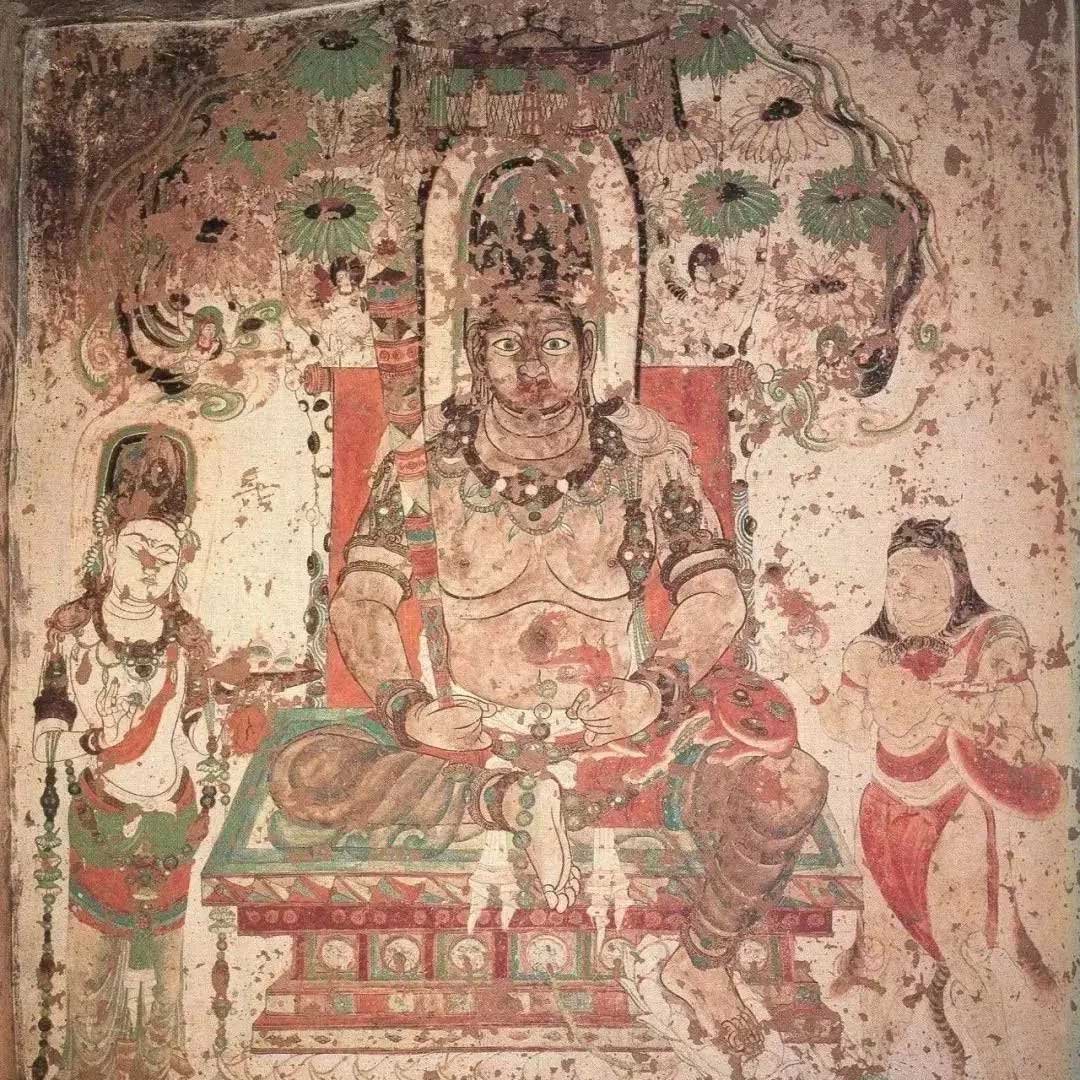
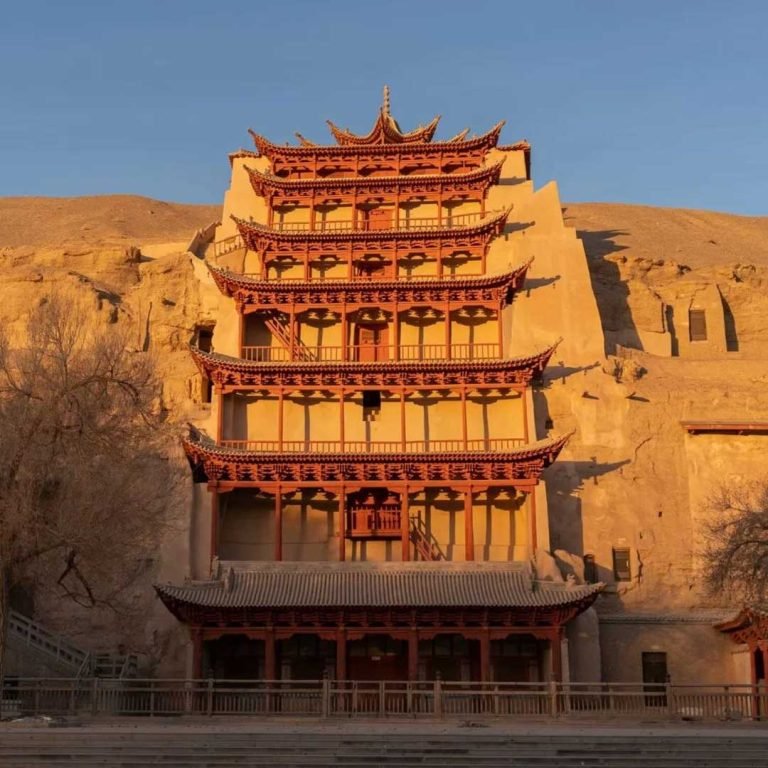
Mogao Grottoes is famed as the “Louvre of the East”, which is outstanding for its exquisite mural paintings and statues. There are now 492 grottoes in which about 45000 square meters long mural paintings and 2100 colorfully painted statues from which you can trace the development of Chinese art over 1600 years from one dynasty to the next because each dynasty built own caves to record its own features. There are about 40 common caves opened to the public. In the tourist area, you will be divided into groups by different tour guides who will accompany you to visit the caves (usually 7~8 caves during April~November and 12 caves during December~March) with great introduction. After that, if you want to visit more other caves, you can do it by yourselves or follow other tour guides. Besides, there are 10 special caves (with extra fees) available for your extensive visit.
The rest of today is free for you to catch your flight/train to the next destination. Your Dunhuang Silk Road tour ends!
Useful Tips:
1. If you want to see the Special Caves (excluded in the regular visit, and only open for limited individual visitors or small groups with reservations), you can contact our travel consultants or your tour guide to arrange for you, but you have to pay the extra admission fee for each cave. 2. To protect the mural paintings, it is not allowed to take photos or use any flashlight inside grottoes.
1. This price is for one person, based on a group of 2 adults sharing one standard double-bed room in a 4-star hotel and traveling with our private tour in low seasons. It will drop greatly if your group has 4 or more members.
2. This price is subject to change according to your traveling season, month and date. There may be huge price increasing during public Chinese holidays, school summer vacations, tourism peak seasons or some special dates. (China Public Holiday 2025 Schedule Released)
3. Other factors that may change the final tour price include group size, hotel class, tour activities, fluctuation of currency exchange rate, etc.
4. This price is based on exchange rate USD 1=RMB 7.00. The final price will be based on the exchange rate in effect at the time of agreement with our quotation.
5. This price is only valid to March 31, 2026.
6. This price is not the final price until the Confirmation Letter is sent.
7. The items included and excluded in this price are for reference only. The final services included, please refer to the confirmation letter sent to you by the travel consultant.
Gansu is celebrated as a golden section of the ancient Silk Road and a cradle of Chinese civilization, making it a paradise for history enthusiasts. It's renowned as a treasure trove of Buddhist art, uniquely housing two of China's "Four Greatest Grottoes" – the Mogao Caves and Maijishan Grottoes. Beyond its historical depth, Gansu boasts diverse natural wonders, including vast Gobi deserts, snow-capped mountains, colorful Danxia landforms, and unique Yardang landforms.
A classic Gansu tour typically begins from Lanzhou, the province's transportation hub. From there, it usually travels northeastward to Dunhuang via Zhangye and Jiayuguan. This route covers the essential ancient Silk Road highlights, including the Mogao Caves, Zhangye Danxia Geopark, Jiayuguan Pass, and the Mingshashan Desert.
The best time to visit the Silk Road in Gansu is generally during spring (May-June) and autumn (September-October). These periods offer pleasant temperatures for exploring the desert landscapes, grottoes, and outdoor historical sites, avoiding the extreme heat of summer and the harsh cold of winter.
Yes, a Gansu Silk Road tour can easily be extended to other parts of the historic route, such as Xi'an in the east or Xinjiang further west, allowing for a more comprehensive Silk Road experience. It can also be combined with other popular destinations in China depending on your overall itinerary.
Given the vast terrain, diverse attractions, and historical significance of the Silk Road, traveling with a specialized agency ensures you get the most out of your trip. Agencies offer first-hand travel information, provide flexible and personalized private tour packages, and ensure comfort and high standards, leveraging their decades of experience as leading experts in the region.
From$820.00 Original price was: $820.00.$708.00Current price is: $708.00.
(0 reviews)
$520.00From$410.00
(0 reviews)
$1,780.00From$1,557.00
(0 reviews)
$1,680.00From$1,361.00
(0 reviews)
$1,080.00From$946.00
Don't just get there, get there in style.
Information
There are no reviews yet.